
|
||
Plastic “Conductors” in SESCADIn addition to non-conductive enclosures, CDEGS now supports the representation of plastic “conductors.” They are conductor-like modeling objects from the standpoint of geometry, segmentation, and placement in the model, while their electrical behavior corresponds to an insulating or very weakly conductive material. In SESCAD, a plastic conductor is specified by right-clicking on one or several conductors, selecting Characteristics and assigning Conductor Type -1 Plastic. As with non-conductive enclosures, plastic conductors carry zero longitudinal and leakage currents and they cannot be energized. When interpreting results, users should remember that a plastic conductor is not an equipotential metallic body. The scalar potential usually varies along the length and cross-section of the conductor. 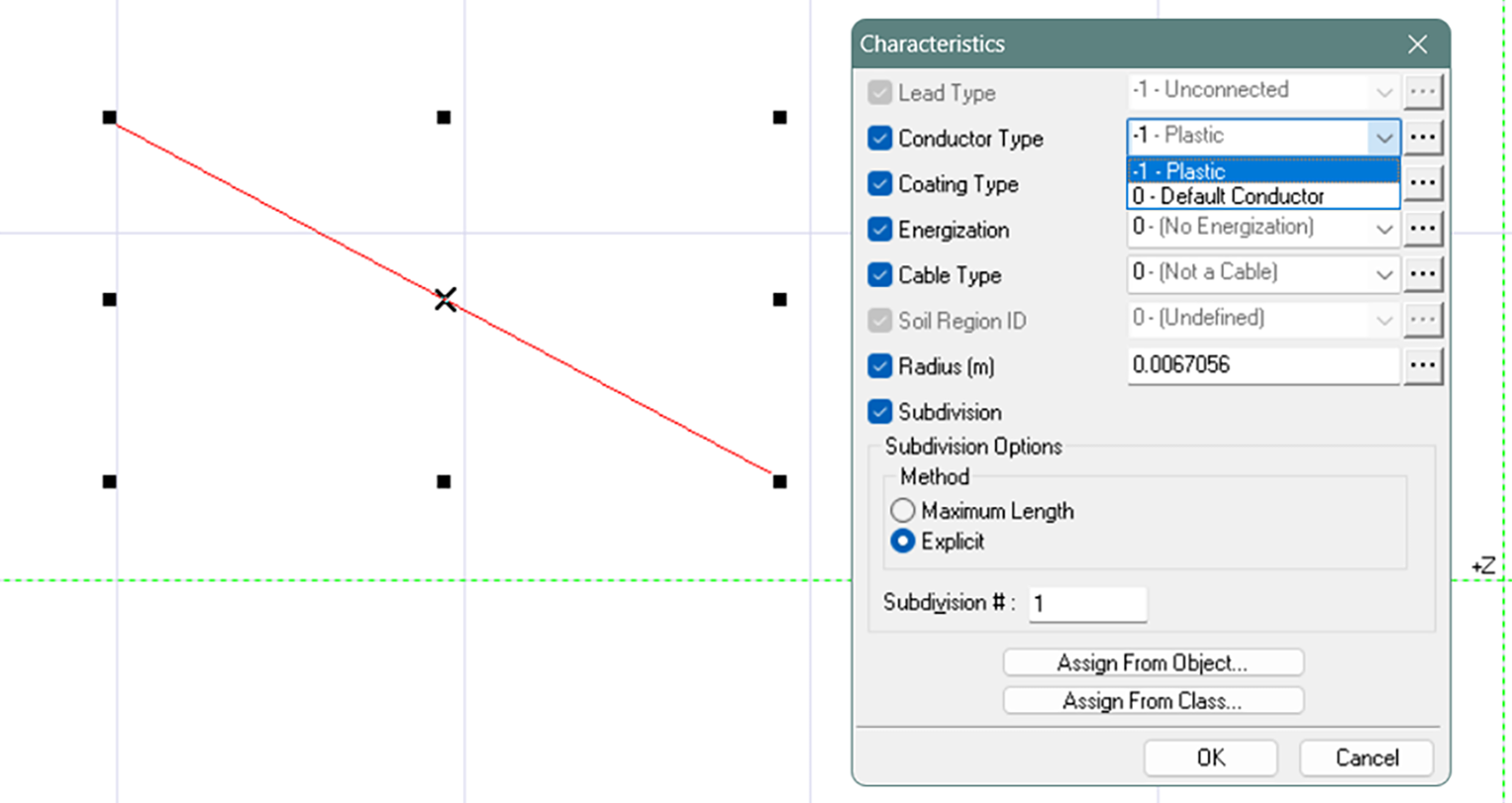
In SESCAD, define a plastic “conductor” by assigning Conductor Type = −1 (Plastic) See the article entitled “Introducing Non-Conductive Enclosures and Plastic “Conductors” in CDEGS” in these Proceedings for further details. |
||
|
||
|
SES & technologies ltd. 3055 Blvd. des Oiseaux, Laval, Quebec, Canada, H7L 6E8 +1 (450) 622-5000 info@sestech.com ©2026 SafEngServices & technologies ltd. |